
Official tournament regulations
2026 season · Doc. AT-CH-2026
Official tournament regulations
ArcheryTime
Championship
FreiBow · Messe Offenburg · 28–29 November 2026
Official tournament regulations
FreiBow · Messe Offenburg · 28–29 November 2026
Competition in the ArcheryTime system · 2025 season
The ArcheryTime Championship was created to determine the best archer of a season under direct competition conditions.
The Season Tournament and the Championship deliberately pursue different goals. The Season Tournament rewards the most consistent performance over a longer period. The Championship, by contrast, decides who prevails in a head-to-head duel against the strongest competitors.
The Season Tournament is the official qualification phase of the ArcheryTime Championship.
Depending on the announcement, a season covers 6, 12 or more months. During this period — depending on the category — between 22 and 44 scoring stations are played: Fun Legend and Hunter Legend comprise 44 scoring stations each (Legend 1 + Legend 2), all other categories 22. The breakdown per category is given in § 3.
Every station may be repeated as often as desired. Only the best result of each station counts towards the ranking.
At the end of the season, the official annual ranking is established.
Alongside the season ranking, ArcheryTime maintains the TrueMaster ranking. The TrueMaster is the average across at least seven completed rounds per station — not a single best result. It also gives the winner of the Championship their title.
| Season Tournament | TrueMaster ranking | |
|---|---|---|
| Principle | Best result per station | Average across a station |
| Attempts | Unlimited within the season — only the best result counts | At least 7 completed rounds feed into the average |
| Result | Official annual ranking · Season Champion | Ranking list for the Championship invitation |
The Season Tournament rewards the single best performance. The TrueMaster ranking measures actual skill on average — it cannot be gamed with one lucky attempt.
The Championship serves solely to determine the True Master. It does not replace the season ranking.
While the season rewards consistency, the Championship evaluates performance under immediate competitive pressure only.
The competition comprises six categories. Each is run as an independent tournament and produces its own True Master.
The categories differ not only in size but in the character of the task: from the entertainment edition with playful objects through tournament-style 3D course situations to purely sporting and Olympic-oriented disciplines. A category is therefore a discipline of its own — results from different categories are not comparable and are never scored against one another.
2026 season: The categories held initially are Fun Legend, Hunter Legend and Sport Dynamic. Hunter Dynamic, Hunter Pro and Sport Pro will follow ⚠️ from the 2027 season; until then, only the season ranking applies to them (§ 9).
Only players who have qualified through the official TrueMaster ranking (§ 1) are invited to the Championship.
Requirements include in particular:
Players who are unconfirmed, uncertified or unavailable are removed from the participant list. Following players move up automatically according to the TrueMaster ranking.
Only after this clean-up is the final Championship seeding list established.
Only archers who have enabled the setting “ACTIVE in Tournement” in their own ArcheryTime profile are considered for the Championship. By doing so, the archer declares bindingly that they intend to take part in the final.
Please enable this setting only if you are reasonably certain that attending the final at FreiBow in November is actually possible. Anyone who is seeded and does not appear blocks another archer's starting place.
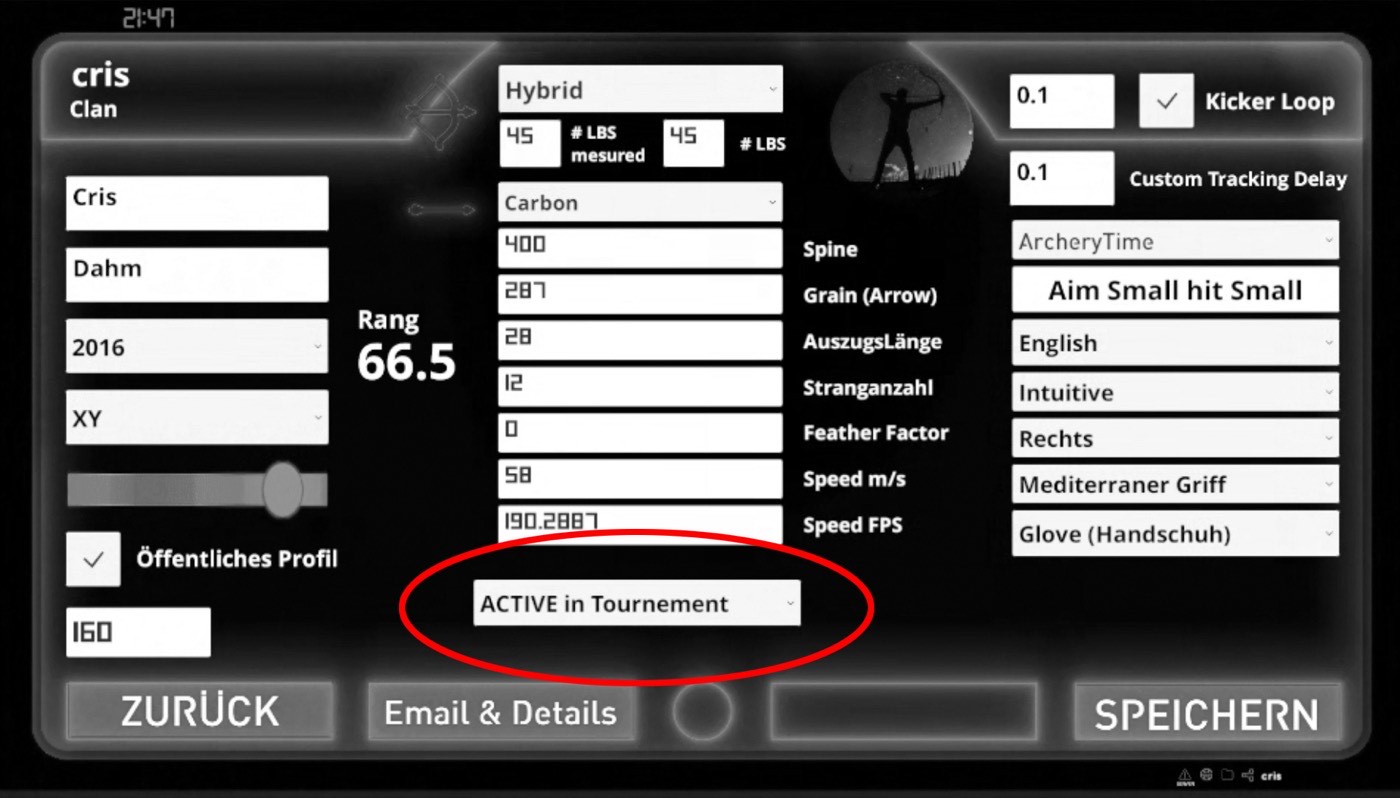
As long as the seeding list has not been finally registered, it is considered provisional: it reflects the current state of the TrueMaster ranking among archers who have declared their participation. A few days before the tournament starts, the list is closed and officially finally registered.
Every participant shoots in the final arena using their own ArcheryTime account. Logging in at the tournament wall happens in person on site and is a prerequisite for starting.
Anyone unable to log in when their match is called cannot start; the match counts as not contested. The tournament management will assist with logging in but cannot reset a password without access to the registered email inbox. We recommend being logged in already at the start inspection.
The seeding list is based solely on the cleaned-up TrueMaster ranking list. The upper half of the seeding list faces the lower half.
| Seed 1 | versus | Seed 11 |
| Seed 2 | versus | Seed 12 |
| … | … | |
| Seed 10 | versus | Seed 20 |
The seed number remains unchanged throughout the tournament. It determines:
Until final registration, the seeding list is provisional. New participants qualifying via the TrueMaster ranking keep joining; the published bracket is therefore updated weekly, and seeding positions as well as pairings may shift from week to week. The list only becomes binding with the final registration a few days before the tournament.
Every participant can view the fully current status at any time:
This gives you the perfect, exact list — up to date to the day and independent of the weekly state of the published bracket.
The Championship is run as a knockout tournament. The winner of a duel advances to the next round. The loser is eliminated.
The bracket is built so that higher-seeded participants meet as late in the tournament as possible.
Every knockout duel is contested in regular ArcheryTime rounds. Both participants shoot the same level under the same conditions.
How many rounds a duel comprises depends on the size of the field. The tournament management sets the mode per category and announces it bindingly before the tournament begins. The mode is not changed once the tournament is under way.
Whether a round is shot in shot-by-shot mode — both participants at the line together, taking turns — is determined by the tournament management together with the mode and announced before the tournament begins.
In a duel, exactly the scoring logic of the respective category applies — the same one used throughout the entire season. Three metrics are used: percentage, time and points.
Targets are fundamentally divided into percentage targets and full targets:
Depending on the category, one of three scoring families applies:
Time only where the category calls for it. In the Hunter categories, time does not count on hits: five shots, avg. hit percentage × 10. Only a complete miss costs the time taken for that shot. The only exception is Hunter Dynamic — there, time is scored regularly.
For the duel, the scoring family is irrelevant: both participants shoot the same level under the same scoring — the higher round result wins. Where time counts, it deliberately remains a minor factor — accuracy decides, but the clock adds the spice to this kind of sport.
For categories with extensive precision rounds (Hunter Pro, Sport Pro), the tournament management may define a shortened tournament version; it is announced together with the invitation. Alternatively, such a category is run without its own Championship — in that case only the season ranking applies (§ 9).
A training version is available for every level of the season: local scoring instead of the online highscore, easy mode, fixed order and always identical flight paths.
Every participant can use it to prepare specifically for the tournament. Training runs earn no points for the season or TrueMaster ranking.
This means every tournament level is equally known to both participants of a duel and can be trained in advance. Whoever shoots second gains no information advantage from watching.
In every match, the higher-seeded participant starts.
The original seed number is not changed at any point during the tournament.
The season ranking and the Championship are maintained independently of each other.
The winner of the season ranking remains the official Season Champion. The winner of the Championship receives the title True Master.
In categories for which no separate Championship is held, only the official season ranking applies.
The Championship is held in one central final arena at FreiBow, Messe Offenburg. This is where all qualified participants come together — every duel of the Championship takes place in this single arena.
The Championship is held on the large lane. The exact wall size within the stated range depends on which wall is installed on site; it is announced before the first arrow and then applies unchanged to all duels of the tournament. This means identical technical conditions apply to every duel — the same wall, the same distance, for everyone.
All bow types are permitted in principle. The bow must be recognisable as a bow.
The limits of 230 fps and 60 lbs are the current upper limit of the tournament wall. If archers with higher draw weights register, the wall will be upgraded accordingly and the limit raised.
The sky draw is prohibited for safety reasons. The bow may only be drawn in the direction of the wall.
Arrows are pulled from the wall by the tournament team as a rule.
Anyone who expressly wishes to pull their own arrows — for instance with wooden arrows or out of personal routine — may do so, but acts at their own responsibility and risk. There is a risk of injury. The referee's clearance must be awaited in any case.
All participants compete in tournament clothing. Street clothing is not permitted at the shooting line.
Permitted are:
Street and everyday clothing is not permitted; jeans are allowed only in plain black. Clothing with offensive prints is prohibited. Advertising by clubs, arenas and sponsors on clothing is permitted.
Arrows are checked as part of the start inspection. Arrows that are objected to must be replaced or cleaned before the first duel.
In case of doubt, the tournament management decides.
All scoring stations of a season are publicly known for months and fully playable by every participant. There is no hidden content of any scoring relevance.
This means nobody has an information advantage — coaches, operators and developers compete under exactly the same conditions as every other player. The Championship Round, too, consists exclusively of levels from the publicly known season pool; content that would be exclusively available to individuals in advance does not exist.
All participants commit to sportsmanlike conduct.
Attempted deception, manipulation or violations of these regulations may lead to exclusion from the Championship.
Playing for time alone is unsportsmanlike: if it is clearly apparent that no attempt is being made to hit and the archer is playing for time only, the referee decides. The round may be annulled; a repeat offence risks disqualification.
Repeating an object is permitted. Calling up an object again consumes time — which acts as a natural time penalty. However, repeating can also be tactically wise: taking another look at an object and going for accuracy often gains more than the clock costs.
The decision of the tournament management is final.
If the wall fails to detect an arrow or detects it obviously incorrectly, the following procedure applies:
The Championship is being held in this form for the first time. The tournament management may refine the procedure for technical faults on site; the principle remains: equal treatment for both participants of a duel.
An objection against a referee’s decision may be lodged with the tournament management. It must be announced immediately after the passe concerned and before the next one begins.
The fee exists solely to limit objections to genuinely disputed cases. It is not a barrier: whoever is right pays nothing.
The Championship takes place publicly at a consumer trade fair and is fully documented. All duels in the final arena are recorded on video.
The recording serves two purposes: securing evidence in disputed scoring and technical tracking errors (§ 12) — and reporting on the tournament.
By participating, participants agree that:
No remuneration is paid for the use of the recordings. For underage participants, the consent of their legal guardians is required.
Consent is voluntary and may be withdrawn with effect for the future. Recordings already published remain unaffected, provided their removal is not possible with reasonable effort. Withdrawal should be addressed to dev@archerytime.de.
Anyone who does not consent to individual portrait shots must inform the tournament management at the start inspection at the latest. The recording of the competition itself in the final arena cannot be waived — it is part of the scoring procedure and therefore a condition of participation.
Every category concludes with its own prize. In addition to the title True Master, a cash prize is awarded.
A cash prize is a deliberate choice: it is straightforward, equally valuable to everyone and leaves each archer free to invest it in exactly the equipment they actually need. Those already shooting at competition level usually own their gear.
| Place | Prize money | Determined by |
|---|---|---|
| 1st place | €200 · True Master | Winner of the final |
| 2nd place | €100 | Loser of the final |
| 3rd place | €50 | Winner of the 3rd place match |
⚠️ The amounts apply per category held. With three categories in the 2026 season, this results in total prize money of €1,050.
A category is held if at least eight participants are seeded. Only from this field size does the full tournament structure result: preliminary round, semi-final, 3rd place match and final.
If fewer than eight participants are seeded in a category, the tournament management decides no later than the final registration of the seeding list whether the category
The decision is made before the first arrow and communicated to all seeded participants of the category concerned. After the tournament has started, any change is excluded.
ArcheryTime reserves the right to adapt or extend these regulations at any time, provided this serves the fairness, safety or further development of the competition.